PCBA Manufacturing Environment Standard Specification
PCBA Manufacturing Environment Standard Specification
Environmental standards
Temperature
- Parameter standard
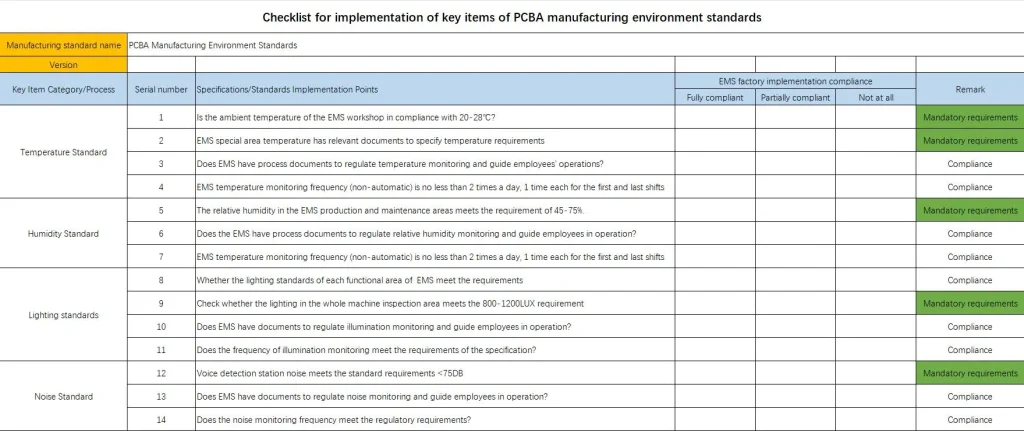
For air-conditioned workshops, according to the provisions of the National Standard of the People’s Republic of China “Indoor Air Conditioning Optimum Temperature” (GB5701), combined with the actual situation of the company, the definition of indoor suitable control temperature is: 20-28℃; for workshops without air conditioning, good ventilation facilities are required, and no control standard is set for temperature; for special functional areas (such as aging rooms, etc.), the relevant specifications and standards of special areas shall be followed. - Monitoring method
Monitoring instrument: Use a fully automatic temperature and humidity measuring instrument or an ordinary ventilation dry-bulb thermometer
Monitoring location: The test instrument should be placed in a place that can fully reflect the surrounding environment, keep a distance of more than 2 meters from the air outlet of the air conditioner, and keep a distance of more than 1 meter from the operator. - Monitoring frequency
For fully automatic temperature and humidity measuring instruments, set data collection every half hour
For other non-automatic test systems, collect data twice per working day, once each for the first and last shifts.
Relative humidity
- Parameter standard
Relative humidity control requirements under normal conditions in manufacturing (including SMT, single board testing, whole machine assembly testing, etc.) and maintenance areas: 45%~75%; special production processes are performed separately according to the requirements of process standards
Relative humidity in other work area environments (or confirmed to be EPA secondary areas) should meet general requirements: 30~75%. - Monitoring method
Monitoring instrument: use a fully automatic temperature and humidity measuring instrument or an ordinary ventilation dry-bulb thermometer
Monitoring location: The test instrument should be placed in a place that can fully reflect the surrounding environment conditions, keep a distance of more than 2 meters from the air outlet of the air conditioner, and keep a distance of more than 1 meter from the operator. - Monitoring frequency
For fully automatic temperature and humidity measuring instruments, set data collection every half hour
For other non-automatic test systems, collect data twice per working day, once each for the first and last shifts.
Illumination
- Parameter Standards
Referring to GB5700-2023 “Indoor Lighting Monitoring Method”, based on the actual situation of the company, the basic requirements for illumination are defined as follows:
| Visual Task Characteristics | Minimum Object Size d (mm) | General Lighting (lux) | Combined Lighting (lux) |
|---|---|---|---|
| Extremely Fine Work | d <= 0.15 | – | 1500-2000 |
| Very Fine Work | 0.15 < d <= 0.3 | 200-300 | 750-1200 |
| Fine Work | 0.3 < d <= 0.6 | 150-200 | 500-750 |
| General Fine Work | 0.6 < d <= 1.0 | 100-150 | 300-500 |
| General Work | 1.0 < d <= 2.0 | 75-100 | 200-300 |
| Rough Work | 2.0 < d <= 5.0 | 50-75 | – |
| Very Rough Work | 5.0 < d | 30-50 | – |
| General Process Observation | – | 10-20 | – |
| Document Storage | – | 5-15 | – |
- Note:
General lighting refers to providing roughly equal lighting levels for the entire lighting area without considering special local needs - Local lighting is set up to increase the illumination of certain specific areas
- Mixed lighting refers to an overall lighting method that combines general lighting and local lighting.
Based on the above standards, the illumination requirements for the main functional areas are defined as follows:
| Functional Area | Illuminance (lm) | Remarks |
|---|---|---|
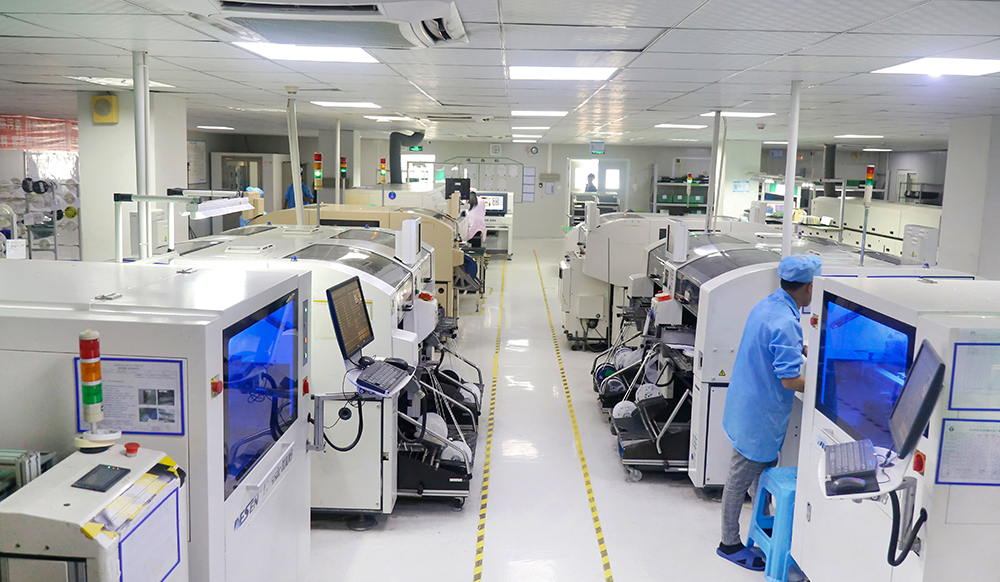
| SMT Inspection | >1000 Temperature >3000K | Mixed Lighting (including tool lighting on workbench) |
| Insertion Line | >1000 Temperature >3000K | Mixed Lighting (including tool lighting on workbench) |
| Soldering Line | >1000 Temperature >3000K | Mixed Lighting (including tool lighting on workbench) |
| Component Assembly Line | >1000 Temperature >3000K | Mixed Lighting (including tool lighting on workbench) |
| Single Board Repair | >1000 Temperature >3000K | Mixed Lighting (including tool lighting on workbench) |
| SMT Operation Area | >200 | General Lighting |
| Debug Area | >200 | General Lighting |
| Final Assembly Test Area | >200 | General Lighting |
| Final Assembly Cabinet Area | >200 | General Lighting |
| Other Monitoring Areas | >200 | General Lighting |
| General Office | >200 | General Lighting |
| Packing Area | >150 | General Lighting |
| Sorting Area | >150 | General Lighting |
| Cabinet Packing Area | >100 | General Lighting |
| Warehouse Area | >100 | General Lighting |
| Aging Room | >100 | General Lighting |
| Warehouse | >15 | General Lighting |
| Final Assembly Appearance Inspection Station | 800-1200 | Mixed Lighting |
| Special Inspection Station | Set As Required | / |
- Monitoring method
Monitoring instrument: illuminance meter
Specific steps: Lay a grid in the monitoring place in advance and mark the measuring points. Generally, the indoor or working area is a 2-4 meter square grid. For a small room, a 1-meter square grid can be used. The grid edge is generally 0.5-1 meters away from each side of the room. If there is no special regulation, the height of the measuring point is generally 0.8 meters above the ground. When monitoring, first use a large range of gears, and then gradually find the gears to be measured according to the size of the indicated value. In principle, it is not allowed to monitor within 1/10 of the maximum range. To improve the accuracy of monitoring, 2-3 readings can be taken at one measuring point, and then the arithmetic average is taken. - Monitoring frequency
Usually, monitoring is done once a quarter
In special cases, when the regional function changes, monitoring should be done once.
Noise
- Parameter Standard
According to the provisions of the National Standard of the People’s Republic of China GB/T 50087-2013 “Design Specifications for Noise Control in Industrial Enterprises”, the following four types of noise standards (A sound level) are determined:
| Area | Noise Limit (dB) | Remarks |
|---|---|---|
| Production Workshops and Workplaces | 80 | |
| Voice Test Workstations | 75 | |
| Workshop Offices, Labs, etc. | 70 | Indoor Background Noise Level |
| Private Offices, Labs, Meeting Rooms, etc. | 60 | Indoor Background Noise Level |
Note:
For workers who are exposed to noise for less than 8 hours a day, the noise limit can be determined based on the actual noise exposure time, and the principle of increasing the noise limit by 3dB for every half of the exposure time. The indoor background noise level refers to the noise that enters from the outside through walls, doors and windows (doors and windows are open and closed as normal conditions) when there is no noise source indoors.
- Monitoring method
Measuring instrument: Noise measurement uses a sound level meter, which should comply with national standards.
Measurement requirements:
For stable noise, measure the A sound level, and the measured value should be marked with dBA, such as 80dBA.
For unstable noise, measure the equivalent continuous A sound level; or measure the exposure time under different A sound levels and calculate the equivalent continuous A sound level (see below).
Reading method: Use slow gear when measuring and take the average reading.
Selection of measuring points: If the A sound level in each part of the area is not much different (less than 3 dB), only 1 to 3 measuring points need to be selected in the workshop. If the sound level fluctuation in each part of the workshop is large (greater than 3 dB), the workshop needs to be divided into several areas according to the sound level. The sound level difference between any two areas should be greater than or equal to 3 dB; the sound level fluctuation in each area must be less than 3 dB, and 1 to 3 measuring points are taken in each area. These areas must include all places and ranges where workers often work and move to observe or manage the production process. Reduce the impact of environmental factors on measurement results When measuring noise, pay attention to avoid or reduce the impact of factors such as airflow, electromagnetic field, temperature and humidity on the measurement results.
Calculation method of equivalent continuous A sound level: Arrange the sound level from small to large and divide it into 5 dB segments, represented by the center sound level. The segments represented by the center sound level are: L1, L1+5, L1+10, L1+15…, and so on. - Monitoring frequency
The workshop noise detection is entrusted to the corresponding professional monitoring agency once a year.
The voice test station test frequency is not less than once a month, and special stations are carried out as required.
Cleanliness
- Parameter Standards
For clean workshops (such as dust-free rooms), refer to the national standards GBJ73/GB 50073-2013 “Cleanroom Design Specifications” and GB/T 25915.1-2021 “Cleanrooms and Related Controlled Environments”. The main parameter standards are as follows:
| Class | Particles ≥0.5μm per Cubic Meter | Particles ≥5μm per Cubic Meter |
|---|---|---|
| Class 100 | ≤35×100 | 0 |
| Class 1000 | ≤35×1000 | ≤250 |
| Class 10000 | ≤35×10000 | ≤2500 |
| Class 100000 | ≤35×100000 | ≤25000 |
For other general industrial plants, the corresponding cleanliness standards are defined as:
| Class | Particles ≥0.5μm per Cubic Meter | Particles ≥5μm per Cubic Meter |
|---|---|---|
| General Plant | ≤25,000,000 | ≤2,000,000 |
| Clean Booth | ≤35×10000 | ≤2500 |
- Monitoring method
Monitoring instrument: dust particle counter
Specific steps:
Determine the number of sampling points:
| Factory Type | Sampling Points (200~400m²) | Samples per Point |
|---|---|---|
| Clean Room | 6~13 | 3 |
| General Plant | 4~8 | 1 |
Determine the minimum number of samples per point:
| Factory Type | Minimum Sampling Volume per Point (L) |
|---|---|
| Clean Room | 2.83 |
| General Plant | 2.83 |
It is necessary to evenly distribute test points in the measured area, and finally calculate the arithmetic mean of all sample points to obtain the cleanliness index of the area.
- Monitoring frequency
The workshop environment is monitored once a quarter.
The dust-free shed (clean room) is monitored by workstation, and the frequency is not less than once a week. When the dust-free shed is measured to be above Class 1000 for three consecutive times, the test frequency can be transferred to once a quarter. When the dust-free level is lower than Class 1000, the normal measurement level must be restored.