

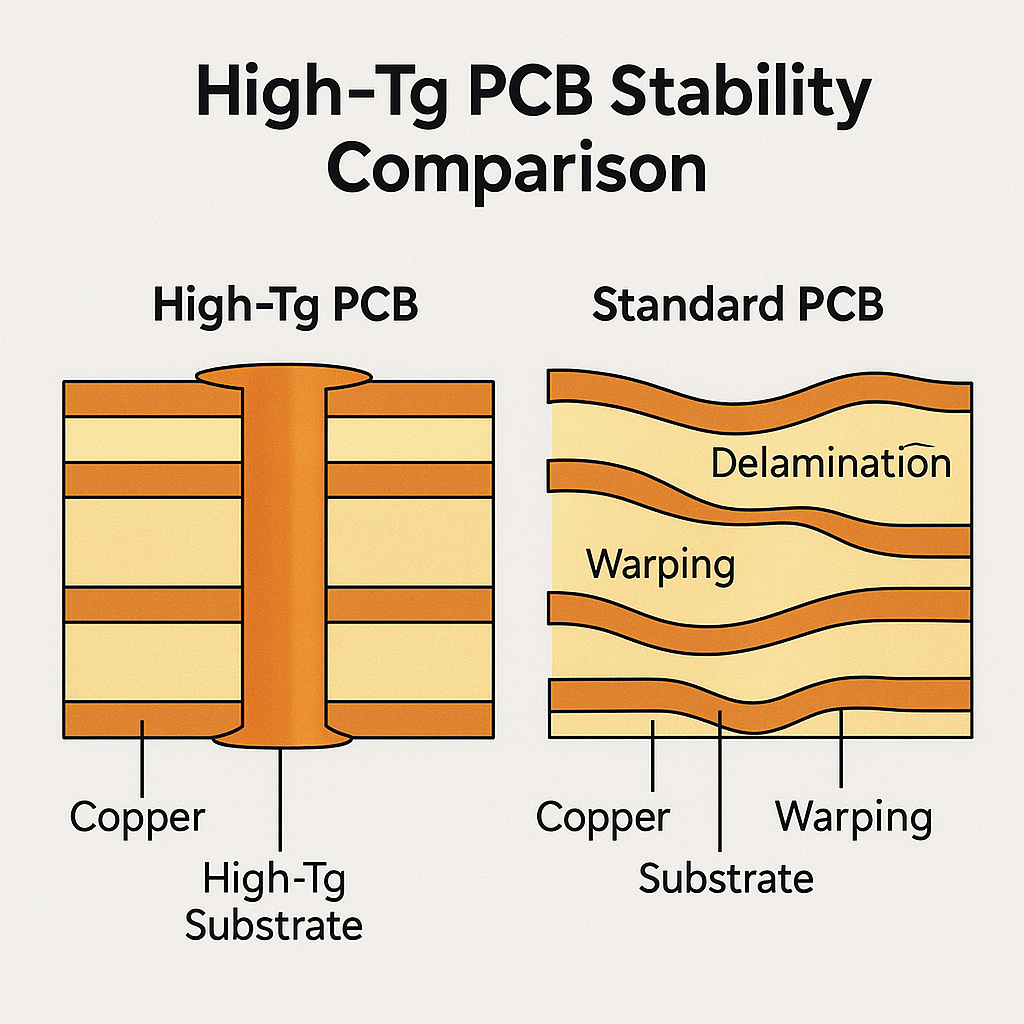
As electronic assemblies operate in higher power densities and more extreme environments, standard FR-4 boards often reach their thermal limits. Components are packed tighter, cooling becomes harder, and boards must resist warping, delamination, and electrical drift under continuous heat.
High-temperature PCB materials—often called high-Tg PCBs—offer enhanced thermomechanical stability and reliability at elevated temperatures. These substrates withstand repeated lead-free reflow cycles and long-term high-temperature operation without compromising electrical performance or mechanical strength.
1.What Is Tg in PCB Materials?
Tg (glass transition temperature) marks the point where a polymer transitions from a hard, glass-like state to a softer, rubbery one.
Tg is a material property, not the full operational temperature rating, which also depends on additives, resin systems, and copper construction.
Below Tg, a PCB’s epoxy resin is dimensionally stable and rigid. Above Tg, its molecular structure gains mobility, causing changes in stiffness, expansion rate, and dielectric properties.Example: “Tg170” indicates a glass transition temperature of 170 °C, meaning the material can sustain continuous operation roughly 20–25 °C below that limit.
2. Effects of Exceeding Tg
When operating above the glass transition temperature:
- Softening and reduced stiffness lead to potential board deformation.
- Warping and layer misalignment can cause registration errors and mechanical failure.
- Delamination occurs as adhesion weakens between resin and copper.
- Via or PTH cracking increases under cyclic stress.
- Electrical degradation appears as impedance drift and higher signal loss.
Design rule: Keep the maximum continuous temperature 20–25 °C below Tg to ensure stability and predictable behavior during thermal cycling.
3.What Qualifies as a High-Tg PCB?
A high-Tg PCB uses resins with elevated glass transition temperatures, allowing safe operation under harsher conditions such as RoHS lead-free soldering and high ambient heat.
Typical Tg classifications:
| Material Type | Typical Tg (°C) | Common Use |
| Standard FR-4 | 130–140 | Consumer, office electronics |
| Mid-Tg FR-4 | 150–160 | Industrial control, moderate power |
| High-Tg FR-4 | 170–180 | Automotive, telecom, server boards |
| Polyimide | 200–260 | Aerospace, defense |
| PTFE / Rogers 4350B | 200–280 | RF, microwave, 5G applications |
| BT Epoxy | 200–250 | IC substrates, high-density modules |
4.Why High-Tg and High-Temperature PCB Materials Matter
1. Lead-Free Manufacturing (RoHS)
Tin-silver-copper (SAC) solder alloys reflow at up to 260 °C.
High-Tg substrates maintain adhesion, resist warping, and prevent copper pad lifting during these cycles—critical for RoHS-compliant production.
2. Thermal Reliability in High-Power Designs
Power converters, motor drives, and logic-heavy PCBs generate heat that stresses material interfaces.
High-Tg materials minimize thermal expansion and maintain solder joint reliability across temperature cycles.
3. Stability in Multi-Layer & HDI Boards
With dozens of layers and microvias, Z-axis expansion mismatch can cause delamination or cracked vias.
High-temperature PCB materials typically offer low Z-axis CTE, improving via reliability and electrical continuity.

5.Key Advantages of High-Tg PCB Materials
- Higher thermal limit: Maintains structural and dielectric stability near 180 °C and beyond.
- Low Z-axis CTE: Prevents microvia and through-hole cracking during reflow.
- Reliable interlayer bonding: Reduces delamination risk across thermal cycles.
- Enhanced PTH strength: Ensures long-term reliability for plated through-holes.
- Stable impedance and low signal loss: Supports high-speed or RF designs.
- Excellent moisture and chemical resistance: Ideal for automotive, aerospace, and industrial sectors.
7.Material Comparison & Typical Applications

| Material | Tg (°C) | Strengths | Common Applications |
| Standard FR-4 | 130–140 | Low cost, general purpose | Consumer electronics |
| High-Tg FR-4 | 170–180 | Cost-effective heat resistance | Automotive ECUs, telecom boards |
| Polyimide | 200–260 | High reliability, extreme conditions | Aerospace, military systems |
| PTFE / Rogers 4350B | 200–280 | Low dielectric loss | RF/microwave modules |
| BT Epoxy | 200–250 | Dimensional stability | IC packaging, power modules |
8.Industry Applications
- Automotive Electronics – Engine control, BMS, and ADAS modules operate near 125 °C ambient; high-Tg FR-4 and polyimide prevent solder fatigue and warpage.
- Aerospace & Defense – Polyimide and BT-epoxy materials endure radiation, vibration, and temperature swings.
- Telecom & 5G Infrastructure – PTFE-based laminates keep impedance consistent in RF front ends and base stations.
- Industrial & Power Electronics – High-Tg FR-4 improves reliability for motor drives, converters, and robotics controllers.
- Medical Devices – Moisture-resistant high-Tg substrates tolerate sterilization and extended duty cycles.
- Servers & Datacenters – Dense power boards and VRMs depend on low-CTE, high-Tg laminates for stable operation.
9.Conclusion
As electronics evolve toward higher power and density, high-temperature PCB materials are indispensable for achieving durability and performance near thermal limits.
By selecting the appropriate high-Tg substrate—whether FR-4, polyimide, or PTFE—designers can reduce warping, delamination, and electrical drift under harsh conditions.
Integrating these materials within a robust PCBA manufacturing process delivers consistent quality and longevity across automotive, industrial, and aerospace applications.
””””””
发表回复